Healthcare · Workflow design · Case study
University Hospitals
Giving a frontline observation an owner all the way through resolution.
- My role
- UX research and interaction design for the High Value Problem Engine proof of concept.
- Project scope
- Frontline submission, manager review and leader resolution.
- Delivery
- Three role-adaptive homes and eight screen designs with functional specifications.
APPROACH / Healthcare · Workflow design
My design process
How I approached the work, from the first question to a concrete design decision.
Understand the handoffs
Combine heuristic review, stakeholder workshops and role-based journeys.
OUTPUTRole & ownership mapShape the submission
Explore chat, voice, progress guidance and author review before submission.
OUTPUTSubmission conceptsDesign for each role
Connect frontline capture, manager review and leader resolution through role-adaptive homes.
OUTPUTThree connected workspacesSpecify the concept
Bring dashboards, interaction states and functional specifications into a traceable handoff.
OUTPUTProof-of-concept handoff
A concern needs somewhere to go
A frontline colleague can describe a problem without knowing who has the authority to resolve it. A submission form solves only the first part. The High Value Problem Engine also had to tell a manager what needed attention and give a leader enough context to take responsibility for a decision.
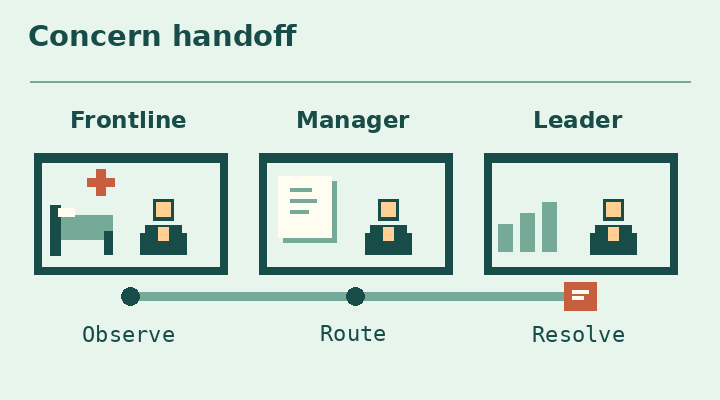
Capture an observation. Review and route the submission. Record the decision and owner.
Follow the concern across roles
Through heuristic review, stakeholder workshops, personas, empathy maps and role-based journeys, I traced what each person contributes. The submitter supplies the observation. The manager assesses and routes it. The leader needs ownership and resolution status. That map shaped the information architecture and dashboards.
Keep the author’s words intact
I explored chat and voice entry with progress guidance and a preview. The proposed assistance could suggest a clearer structure beside the original words. The author could edit or decline it before submission. This preserved the difference between what a colleague observed and how the system offered to organise it.
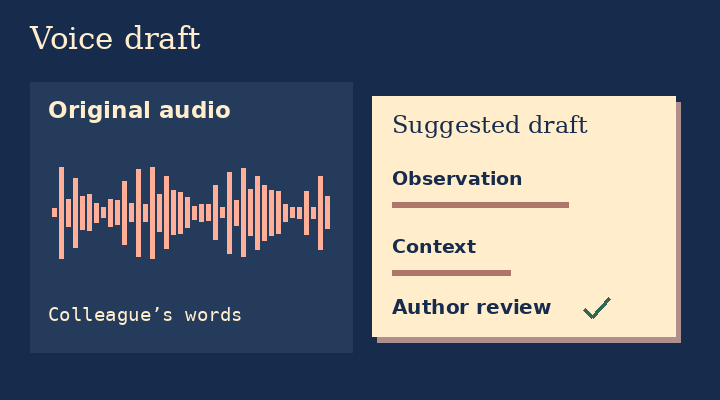
Start with the colleague’s words. Preview how the idea is organised. Edit or decline before submitting.
Give the reviewer a decision to make
The three-panel workspace connected the issue, its context and the available action. Role-specific homes kept review queues and resolution decisions visible to the people responsible. A review could follow one concern across all three homes and inspect where its history or ownership might become ambiguous.
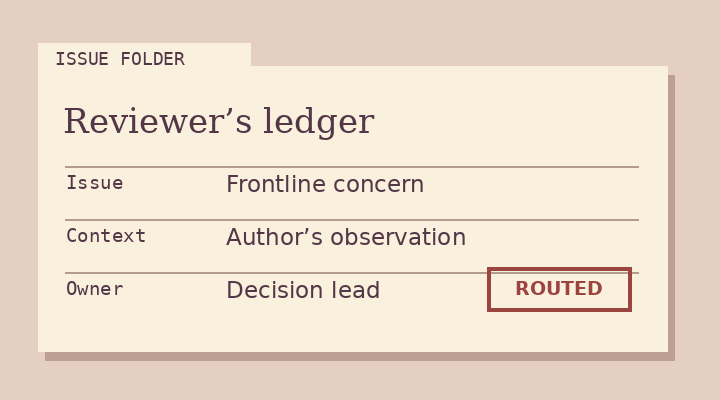
Open the submitted concern. Make the next reviewer visible. Record what was decided.
Design decisions
- Frontline colleague
- Capture, preview and submit an observation.
- Manager
- Review the queue and route the concern.
- Leader
- See the owner, record a decision and track resolution.
Outcome
The workshop-led proof of concept produced three role-adaptive homes and eight specified screens. The handoff joined the system map, dashboards and interaction states into one traceable workflow.
What I would measure next
The next test is whether each participant can identify who owns the issue after their action.