Enterprise UX · Case study
Seaboard Foods
Taking a receiving decision from a green-screen program to a web interface operators could recognise.
| Record | Classification |
|---|---|
| R–041 | Reviewed |
| R–042 | Unassigned |
- My role
- Senior UX designer and design engineer, working with analysts, engineering and client operations.
- Project scope
- Hog procurement and evaluation, contract management and receiving.
- Delivery
- 3–5 days to 1–2 days per program in the design workflow.
APPROACH / Enterprise UX
My design process
How I approached the work, from the first question to a concrete design decision.
Trace the legacy rules
Map fields, permissions and exceptions with analysts and operations.
OUTPUTLegacy task mapMake the direction tangible
Use Phase 0 wireframes and mock-data React screens to compare the proposed behaviour with the original program.
OUTPUTReviewable prototypeSet reusable standards
Define filters, frozen identifiers, validation and keyboard behaviour across modules.
OUTPUTUX standards & decision logFollow through to delivery
Review differences with the client and track design-fidelity deviations through UAT resolution.
OUTPUTImplementation review
The record an operator cannot afford to lose
A receiving operator looking up a hog classification and a contract specialist checking deductions both work with dense records. The identifiers have to survive scrolling, sorting and editing. Modernising the AS/400 suite meant deciding which behaviours carried business meaning before changing how a screen looked.
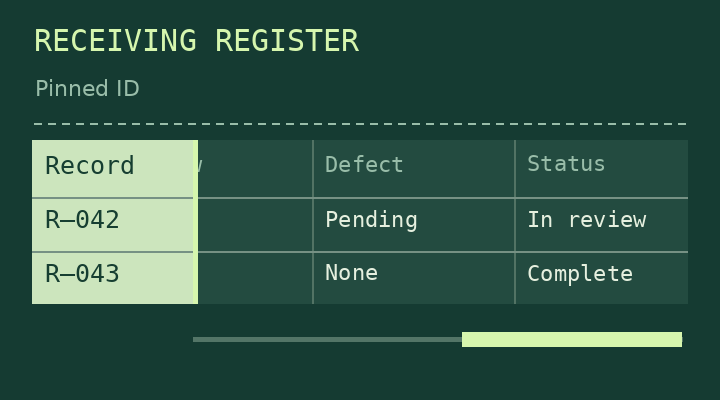
Find the receiving record. Read across the row. R–042 stays in view.
Trace one program before drawing its replacement
I mapped legacy menus, fields and exceptions with analysts and client stakeholders. Phase 0 wireframes gave us an early way to discuss the task. We then built React screens on mock records and compared them with the legacy program. A difference in a field, rule or permitted action became a review decision before the client approved that program.
Make the grid answer an operational question
A blank classification can be precisely what someone needs to find. I specified blank-value filters alongside populated values, server-side filtering and pagination, frozen identifiers and keyboard movement. The same conventions carried into contracts, procurement and receiving, while each module kept its own terminology.
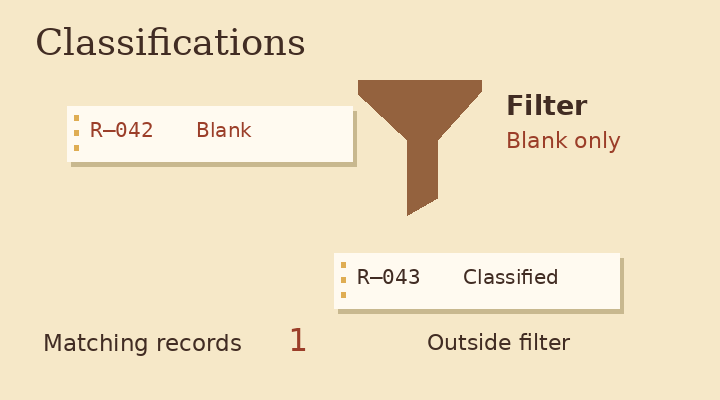
Two illustrative records shown. Include blank values. One record needs attention.
Carry decisions into delivery
I ran design-system and accessibility workshops, documented UX Standards v1.0 and tied more than 50 components to a decision log. The engineering handbook connected design choices to their business rationale. During UAT I tracked more than 40 design-fidelity deviations through resolution. Wave 2 included hog defects and classifications.
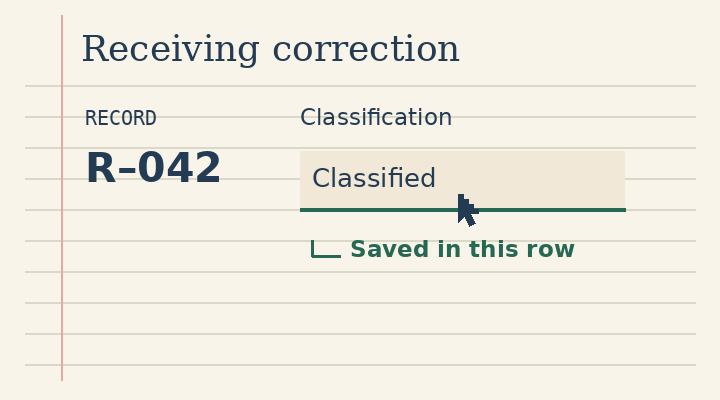
The operator changes a value. Mark the field in its row. Keep the record visible.
Design decisions
- Missing classification
- Let the operator filter for a blank value.
- A wide receiving table
- Keep the row identifier visible while its details scroll.
- An edit fails validation
- Keep the affected field and correction visible in context.
Outcome
The AI-assisted, human-reviewed workflow brought design time per program from 3–5 days to 1–2. Reuse of approved patterns reduced developer rework and review rounds by up to 70% at peak. These figures describe delivery performance.
What I would measure next
For operational impact, the next comparison is time and errors on the same receiving task before and after rollout.